

Materials and finishes
Each finish is matched against your material library first. If a very similar name exists, the build stops and asks whether to reuse it.
AI configurator builder
Tell Simplio3D what you sell and its AI plans and builds a configurator around the 3D models in your library: materials, options, rules, a price and a form. You review the plan, approve anything that touches money, and publish when it is ready.
No credit card required
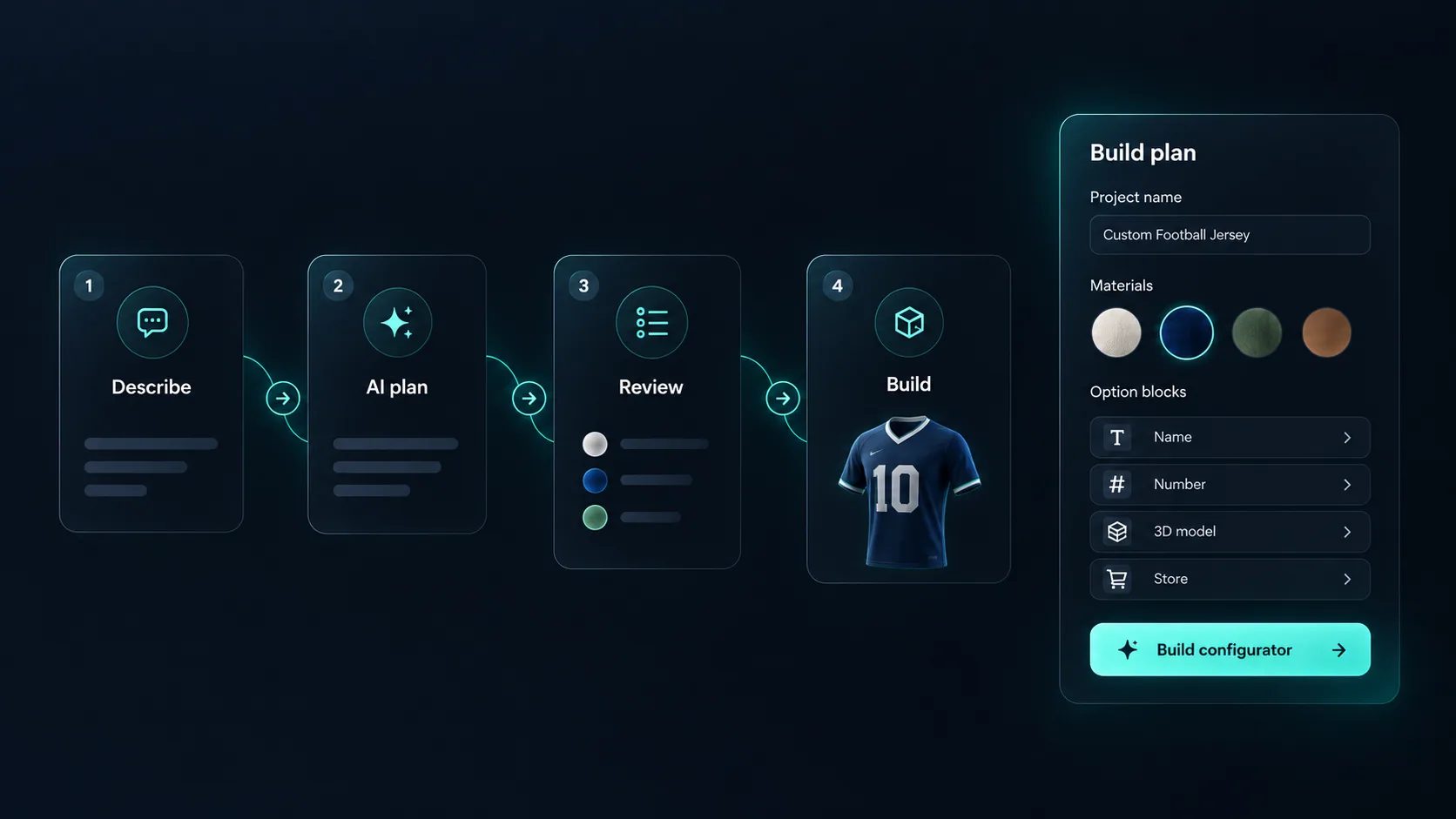
Each finish is matched against your material library first. If a very similar name exists, the build stops and asks whether to reuse it.
The choices you described, such as a frame finish or a seat cover, set up as blocks your customers will use.
Simple rules between options, listed in the plan so you can delete any you do not want.
Proposed with the amount and currency from your plan. It waits for your approval before it is applied.
The form fields you need, so a configuration can reach you as a request.
With Shopify or WooCommerce already connected, it proposes the product link and checkout mode, each for your approval.
Vea cómo los usuarios puntúan Simplio3D en las principales plataformas de reseñas de software.

4.6/5

4.3/5

9.5/10
Five steps, starting from Generate with AI on your Projects page.
Say what you are selling, for example “a lounge chair configurator with oak, walnut and black frames, and a fabric or leather seat”.
The Build plan panel fills in as you talk: project name and type, 3D models, materials, option blocks, rules, pricing, form and store checkout. Remove anything you do not want.
If a model or texture is not in your library yet, upload it from the same dialog. It lands in your normal Assets library.
A checklist ticks off each step. It pauses when it needs an answer from you, and again for each change that needs approval.
Open the draft in the editor to confirm the 3D targeting and adjust variants and pricing. Carry on by hand, or ask the AI assistant.
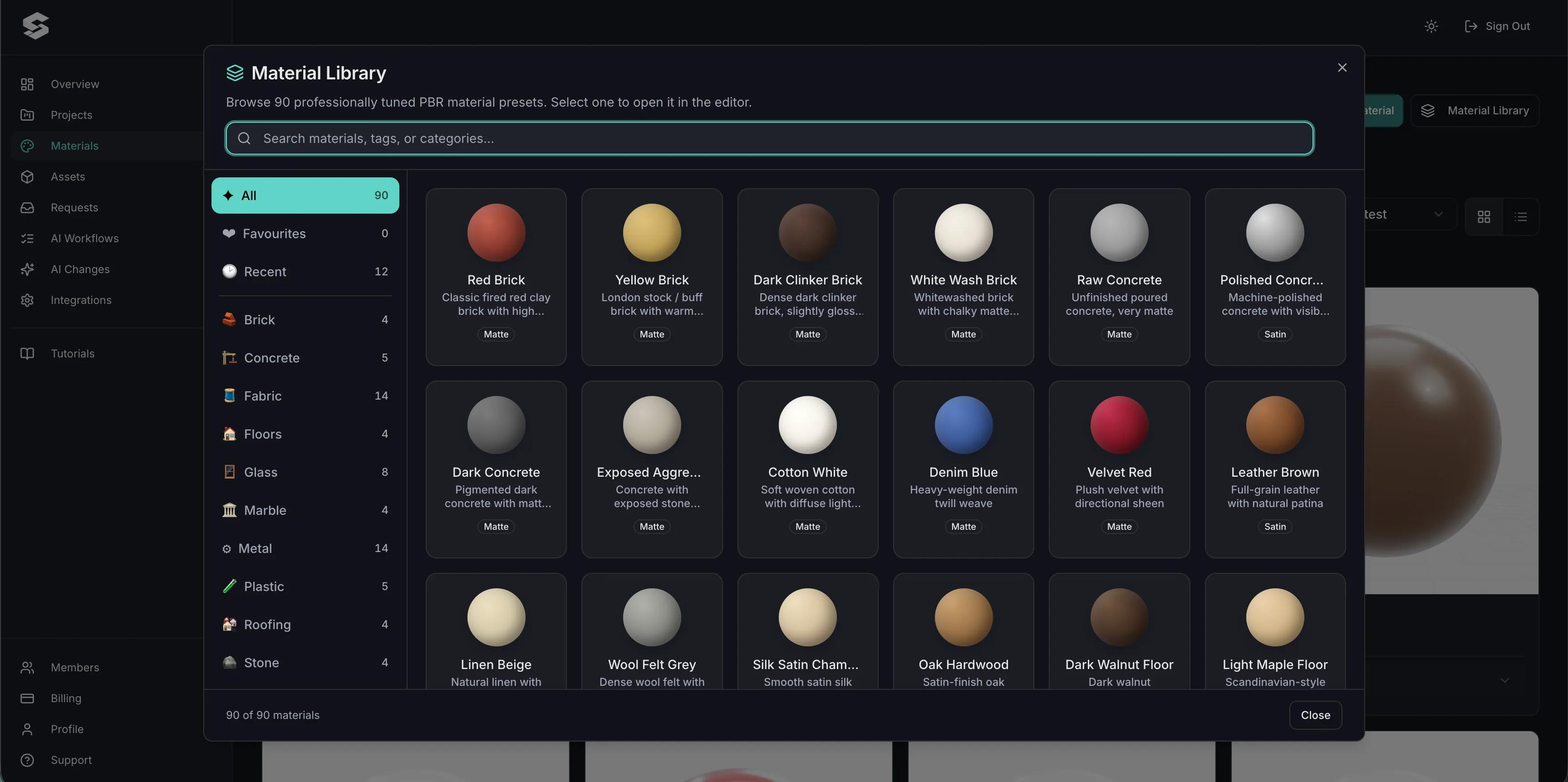
The AI works with the models, textures and graphics already in your library. If a model is missing it says so and offers an upload, rather than attaching something unrelated. For a model you do not have yet, you can upload your own files, or import a free one from an online library such as Poly Haven, Sketchfab or the Smithsonian.
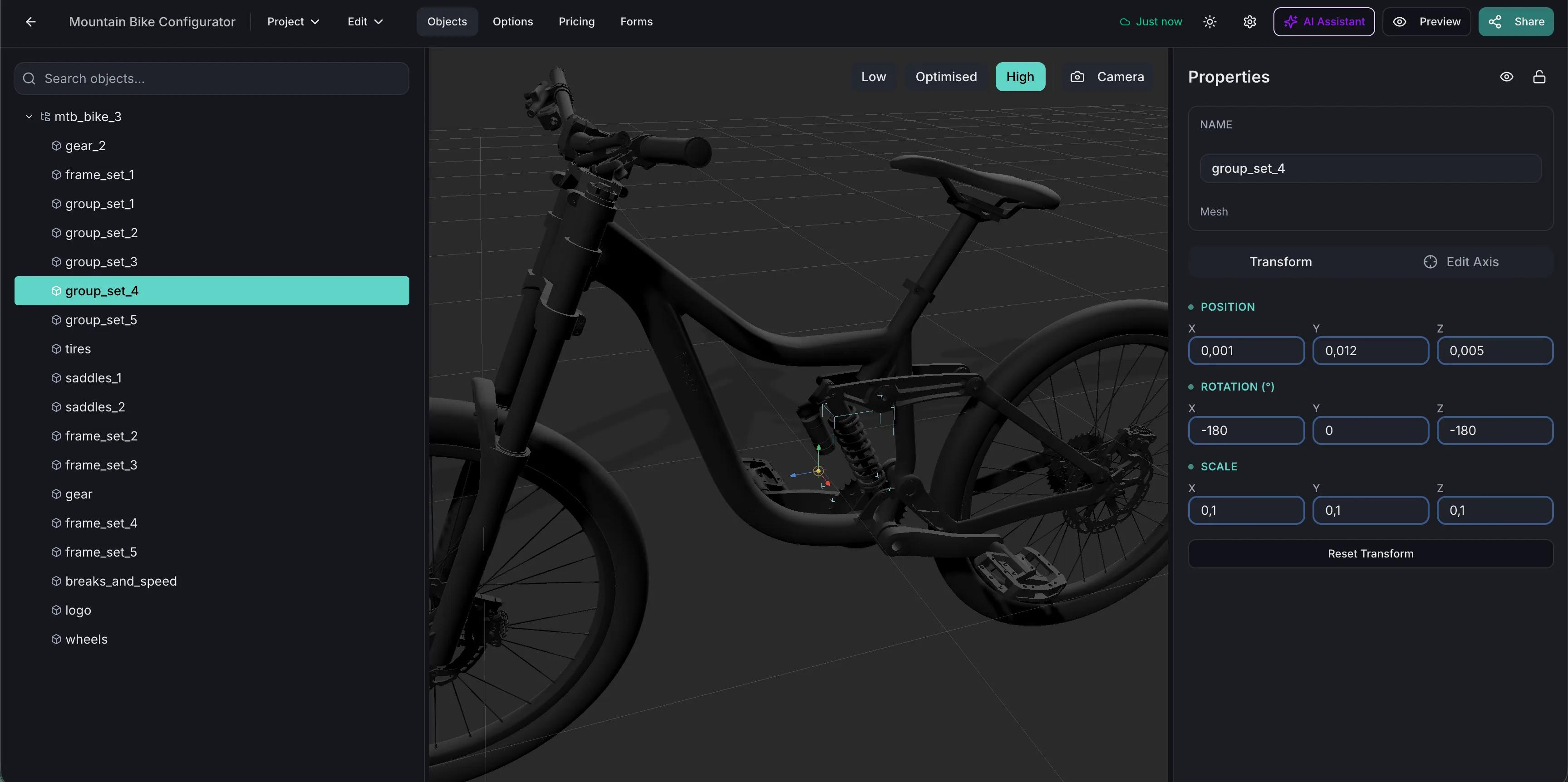
Inside a project, the assistant reads your blocks, rules and even the part names in the 3D file. Ask it to “add a size option” or “audit this configurator”, and an audit gives you a health score with every finding, split into safe fixes and decisions for you. Sensitive changes wait for your Apply, and most changes can be undone.
The plan is yours to edit, and your edits win over the assistant’s suggestions.
| Step | The AI | You |
|---|---|---|
| Project and 3D models | Plans the project around models in your library | Attach any model that is missing |
| Materials | Reuses what it recognises, creates the rest | Choose when a similar material already exists |
| Options and rules | Creates the blocks and show or hide rules in the plan | Confirm the 3D targeting in the editor |
| Base price | Proposes the amount and currency | Apply or decline |
| Store product link and checkout mode | Proposes them if a store is already connected | Apply or decline, and connect the store yourself |
| Modular setup | Attaches modules and creates materials and pricing | Finish module variants and snap sides by hand |
| Publishing | Never | Turn on sharing when it is ready |
Connect Claude, Cursor or VS Code over MCP. A connection starts read-only, write access is ticked per area, and high-risk changes only ever become proposals you apply in the dashboard.
Product configurator MCP guideThe Simplio3D plugin for Claude adds the connector and seven skills, so Claude can build from a brief, audit a project and check whether it is ready to publish.
Claude plugin tutorialThese configurators were built by hand, without the AI builder. They show what the platform can do once a project is refined: a chair range on one material library, a cart its own team maintains and a tent with a design canvas on every panel.
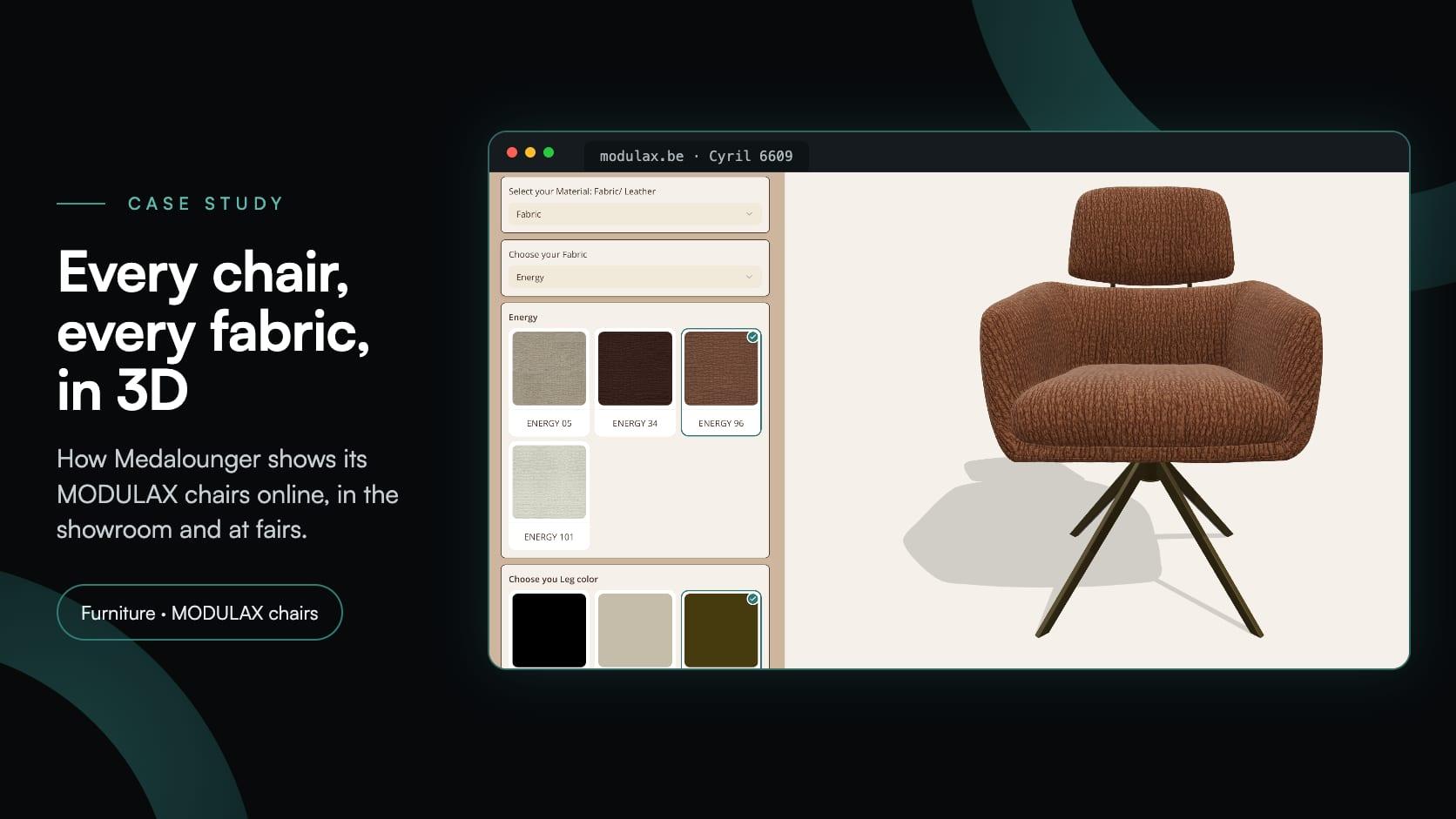
Medalounger
Medalounger, el fabricante belga de muebles MODULAX, creó 51 configuradores de sillas a partir de una biblioteca de 161 materiales para su sitio web, su sala de exposición y su stand en ferias del mueble.
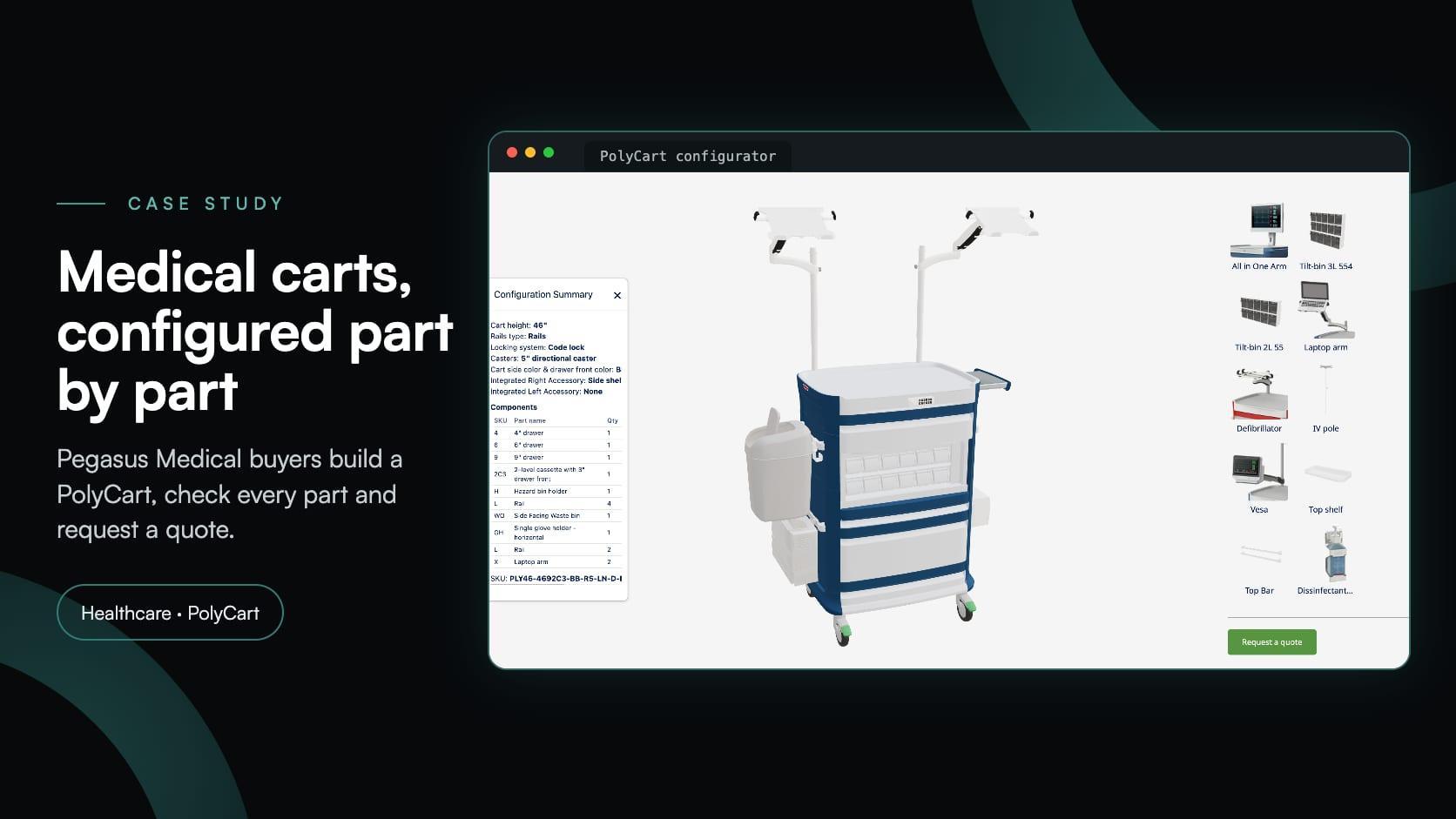
Pegasus Medical
Pegasus Medical quería que los compradores configuraran carros médicos PolyCart en 3D y solicitaran un presupuesto, sin pagar por software personalizado. Simplio3D ayudó a ponerlo en marcha; ahora su equipo lo gestiona.
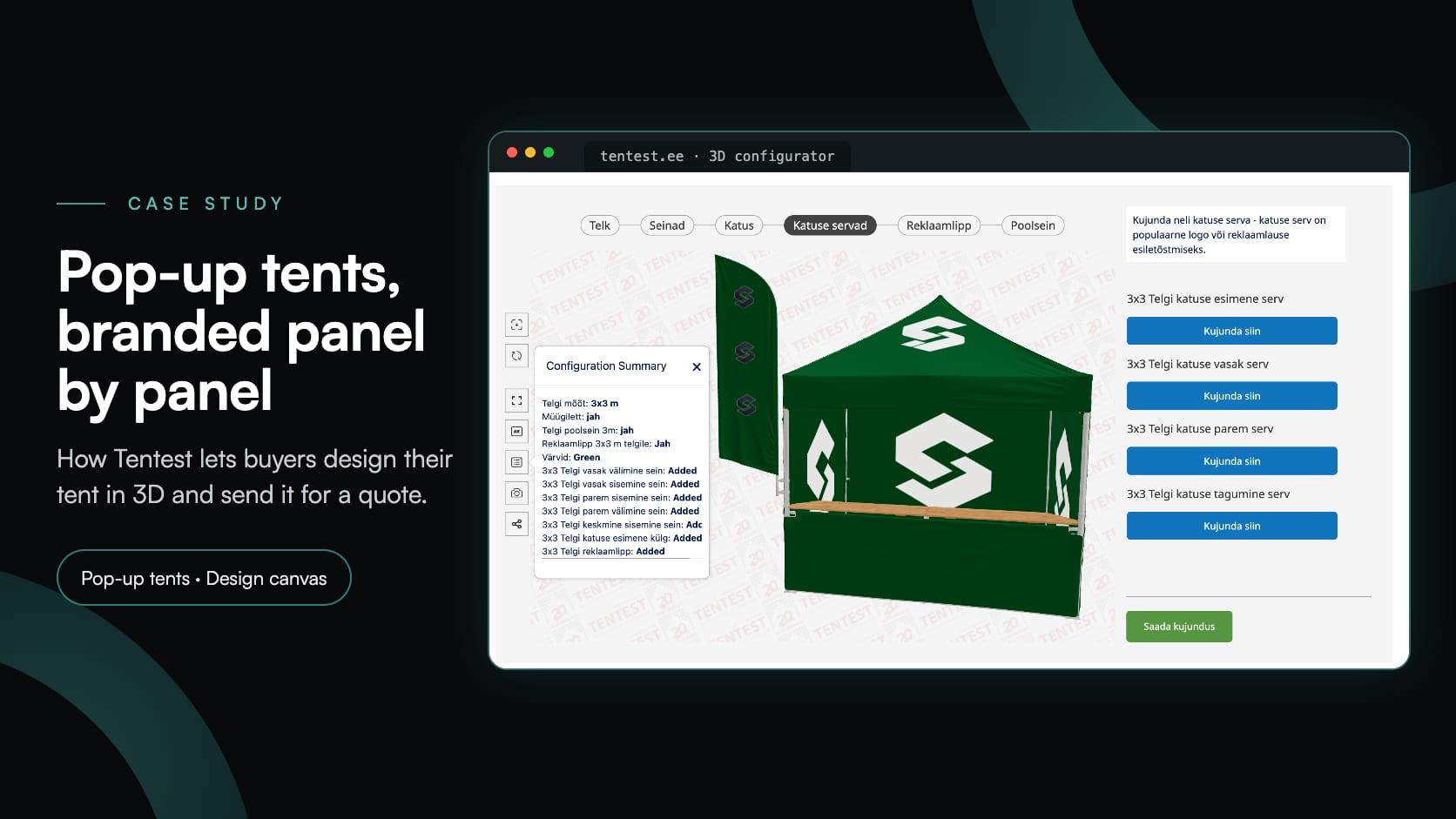
Tentest
Tentest, fabricante estonio de carpas plegables del grupo Scandipro, creó su propio configurador 3D: seis tamaños de carpa, un lienzo de diseño con carga de logotipos en cada panel, AR y una solicitud de presupuesto.
Here it means a configurator built with AI help. You describe the product, and the AI plans and creates the project: materials, option blocks, rules, a price and a form. The customers who use it see a normal configurator.
No. It can only use assets that already exist in your library, and it can read their part names. You upload your own model, import a free one from an online library, or start from the 3D Model Library.
No, and it is not meant to be. It is a first draft: the structure is in place, and you review and refine it before customers see it. Nothing is published until you turn on sharing yourself.
No. The base price, the store product link and the checkout mode each wait for your approval. In the AI assistant and connected AI tools, pricing, SKUs, deletions and bulk edits become proposals you apply.
Generate with AI, the AI assistant and AI connections are available on every paid plan, Starter included, and in the 30-day Pro trial. Modular projects are not on Starter.
Yes, if the store is already connected: it can search your products and propose the link. It cannot connect a store for you or read store credentials. That stays with you, in Dashboard → Integrations or your Shopify admin.
The documentation gives step-by-step setup for Claude, Claude Desktop, Claude Code, Cursor and VS Code with GitHub Copilot. Anything a connected tool reads is sent to that tool’s AI provider, so grant only the access it needs.
The editor the draft opens in: option blocks, conditional logic and pricing you can change by hand.
What a product configurator is, how it works and where it is used.
The decisions in order, from requirements to launch, and where AI helps.
Guías, tutoriales y noticias del equipo de Simplio3D.
Cómo se construye un configurador de productos (Flujo de trabajo 2026)
Las decisiones que determinan si un proyecto de configurador tiene éxito: definir los requisitos, elegir el tipo de proyecto, construir opciones, lógica y precios, y dónde la IA ahora realiza el trabajo.
Cómo usar el plugin Simplio3D WordPress en Elementor
Añade el visor de Simplio3D, las opciones, el precio, el resumen y el botón Añadir al carrito en Elementor con el widget Shortcode gratuito: encuentra tus ID, crea el diseño y conecta WooCommerce.
Plugin de Configurador de Productos Simplio3D para WordPress
Incorpora un configurador de productos 3D en WordPress y permite a los clientes añadir su producto configurado directamente a la cesta de WooCommerce — con el precio calculado según tus propias reglas.
Preparación de Modelos 3D para Simplio3D: Una Guía Práctica
Estructura, mapeo UV, optimización y pivotes: las cuatro cosas que deciden si un modelo 3D se convierte en un configurador funcional o en un ejercicio de resolución de problemas.
Product Configurator MCP: Connect Claude, Cursor and VS Code to Simplio3D
Los conectores MCP permiten que Claude, Cursor o VS Code trabajen con tus proyectos reales de Simplio3D. Qué puede leer y modificar un agente conectado, cómo funciona la aprobación y cómo conectar uno.
Posee un configurador de productos 3D para impulsar ventas y generar propuestas directamente desde tu sitio web.


